
Shoulder Fractures & AC Joint Injuries

Anatomy of the Shoulder
The shoulder consists of three bones: the clavicle, or collarbone; the scapula, or shoulder blade; and the proximal humerus, which is the rounded uppermost part of the arm bone. These bones intersect to form two joints in the shoulder. A fracture, or break, can occur in any of the bones in the joint as the result of a fall, sports injury, or accident.
Muscles, tendons, and ligaments surround and stabilize the joint and help prevent the bones from moving out of place. These may also be injured when a fracture occurs.
The type of fracture and the extent of the injury will be determined based on an X-Ray, MRI, CT scan, or musculoskeletal ultrasound. Fractures are classified as follows:
Closed fracture: The broken bone remains beneath the skin.
Open fracture: a fragment of the bone breaks through the skin.
Displaced fracture: Bones are separated into two or more pieces that don’t remain in contact with each other.
Nondisplaced fracture: Pieces of the broken bone don’t separate and the bone fragments remain in place.
Injury to muscles, tendons, ligaments, and nerves surrounding the shoulder joint will also need to be assessed.
Shoulder fractures require immediate care to heal and prevent permanent damage to the bone or surrounding soft tissues.

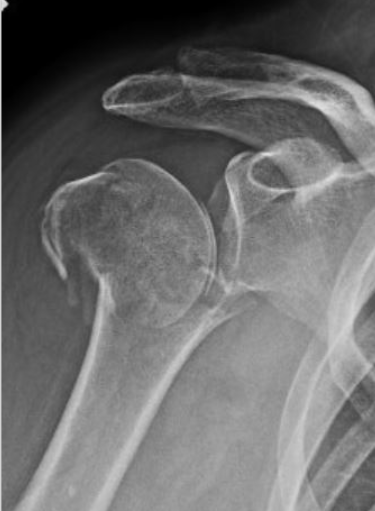
X-rays of a Normal Shoulder


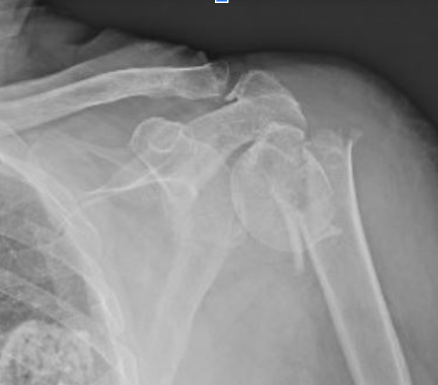
Shoulder Fractures

Types of
Shoulder Fractures
-
The clavicle, also called the collarbone, is a long bone that connects the shoulder blade to the breastplate, or sternum. A broken collarbone is the most common type of shoulder fracture.
A broken collarbone may also cause the shoulder to sag downward, and a bump may be visible beneath the skin where the bone has fractured. If the fracture is caused by a high-impact injury such as a car accident, the bone may stick through the skin.
-
The scapula, or shoulder blade, is a large, flat, triangular bone on your back that connects the humerus, or upper arm bone, and the clavicle, or collarbone. The shoulder blade is well protected by surrounding muscles and doesn’t break easily, but a high-energy, direct impact can cause the bone to fracture into two or more pieces.
Shoulder blade fractures are rarely open fractures, and they may not require surgery to heal.
-
The proximal humerus is the upper part of the arm bone that forms the ball of the shoulder joint. This is a very common fracture in older patients, especially those with osteoporosis. Commonly they occur from a fall from standing, but can also occur with a shoulder dislocation or higher energy injury, such as a car accident.
Non-displaced proximal humerus fractures are treated with immobilization in a sling. Proximal humerus fractures that are displaced or more complex may require surgery. Depending on the pattern of the fracture as well as patient-specific factors, such as age and activity level, the fracture may be fixed with plates and screws or with a shoulder replacement.
-
The humerus (the arm bone between your shoulder and elbow) can break in different areas. The most common area is the proximal humerus. Fractures can also occur in the middle of the bone or closer to the elbow. Treatment of these fractures depends on the pattern of the fracture.
-
Injury to the AC joint (a small bony prominence on the top of the shoulder) is common in athletes. It usually occurs from falling directly on the shoulder. The most common injuries are to the ligaments that hold the AC joint together. This is called an AC separation or a shoulder separation. In an AC separation, the clavicle (aka collarbone) sticks up above the acromion (part of the scapula). An AC joint separation causes a bump on the top of the shoulder. Depending on the amount of separation between the two bones treatment may be immobilization in a sling or surgery.

Treatments for Shoulder Fractures
-
Avoid activities that re-create the sharp pain as best as possible. Limit repetitive reaching or lifting.
-
Ice packs should be applied to the shoulder to help with pain.
-
Physical therapy is important to strengthen and rebalance the muscles of your shoulder. PT helps decrease pain and inflammation in the shoulder.
-
NSAIDS such as ibuprofen or naproxen help with swelling and pain.
Corticosteroid Injections: Ultrasound-guided injections of corticosteroids around the rotator cuff can provide improvement in pain and inflammation.
-
Whether a fracture can be treated conservatively or with surgery depends on multiple factors including patient age, activity level, the pattern of the fracture, and the amount of displacement. Fractures around the shoulder typically are fixed with a plate and screws. This construct holds the fracture in place until the bone heals. The exception is certain proximal humerus fracture which may require a reverse shoulder replacement. Dr Walcott will talk to you about which options are best for you.