
Shoulder Instability & Labral Tears

Understanding Shoulder Instability: Dislocations and Labral Tears
Shoulder instability happens when the ball of the shoulder slides out of place and isn't restrained properly by ligaments and cartilaginous labrum.
Shoulder Dislocation: When the humeral head (the ball of the shoulder) comes completely out of place, it is a shoulder dislocation. This needs to be reduced or put back into place by a trained professional, usually in the Emergency Room. Shoulder dislocations occur from an athletic injury, fall, or motor vehicle crash. The shoulder most commonly dislocates anteriorly, where the ball dislocates in the front of the cup. The shoulder can also be dislocated posteriorly, where the ball is dislocated behind the cup. When the ball only partially comes out of place, this is known as a subluxation. A subluxation usually reduces on its own within a few seconds.
The risk of another shoulder dislocation depends primarily on age and the amount of damage caused by the dislocation to the labrum and bone. Young athletes with a shoulder dislocation have a very high risk of another shoulder dislocation.
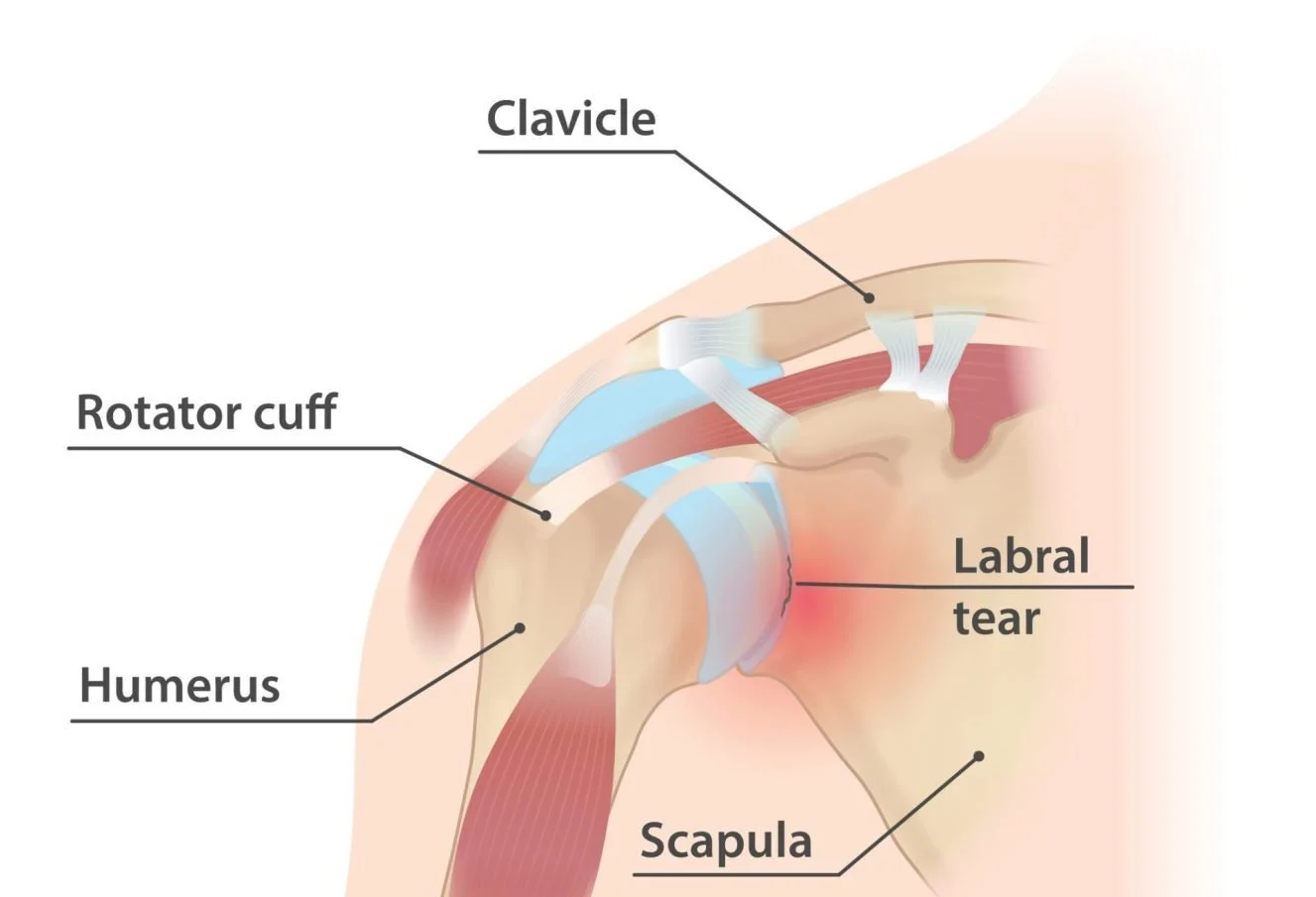
Labral Tear: The labrum is a cartilage gasket that helps deepen the socket and keep the ball in place. The labrum can tear in the front (anterior), top (SLAP tear), back (posterior), or any combination of those. The labrum tears in almost all shoulder dislocations. Labral tears occur both with an acute injury and with repetitive stress of overuse. When the shoulder dislocates anteriorly (the ball in front of the glenoid), the anterior or front of the labrum usually tears.
Posterior Labral Tear
Anterior Labral Tear



Non-Surgical Conservative Treatments
-
Following a dislocation, a trained professional can often manipulate the shoulder joint to realign it into the proper position. This can be done by an athletic trainer on the sidelines or a physician in the emergency room.
-
Rest the injured shoulder and avoid activities that require reaching out to the side with your elbow away from your chest. A sling may be worn for one week to facilitate healing
-
Ice packs should be applied to the affected area for 20 minutes every hour.
-
Physical Therapy usually starts 1-2 weeks after a shoulder dislocation. It is designed to strengthen the muscles that help hold your shoulder in place and decrease pain and inflammation in the shoulder.
-
NSAIDS such as ibuprofen or naproxen help with swelling and pain.
Surgical
Treatments
Dr. Walcott will discuss which treatment options are best for you depending on many different factors.
-
Minimally invasive surgery where Dr. Walcott makes small incisions around the shoulder and performs the surgery through an arthroscope. The labrum is repaired with suture anchors placed in the bone and the labrum is tied back into place.
-
Depending on the quality of the labrum and capsular tissue and glenoid bone loss, a Latarjet surgery may be recommended. This surgery takes bone from the coracoid (small bony prominence at front of shoulder) and moves it with the attached tendon to the front of the glenoid (socket).